
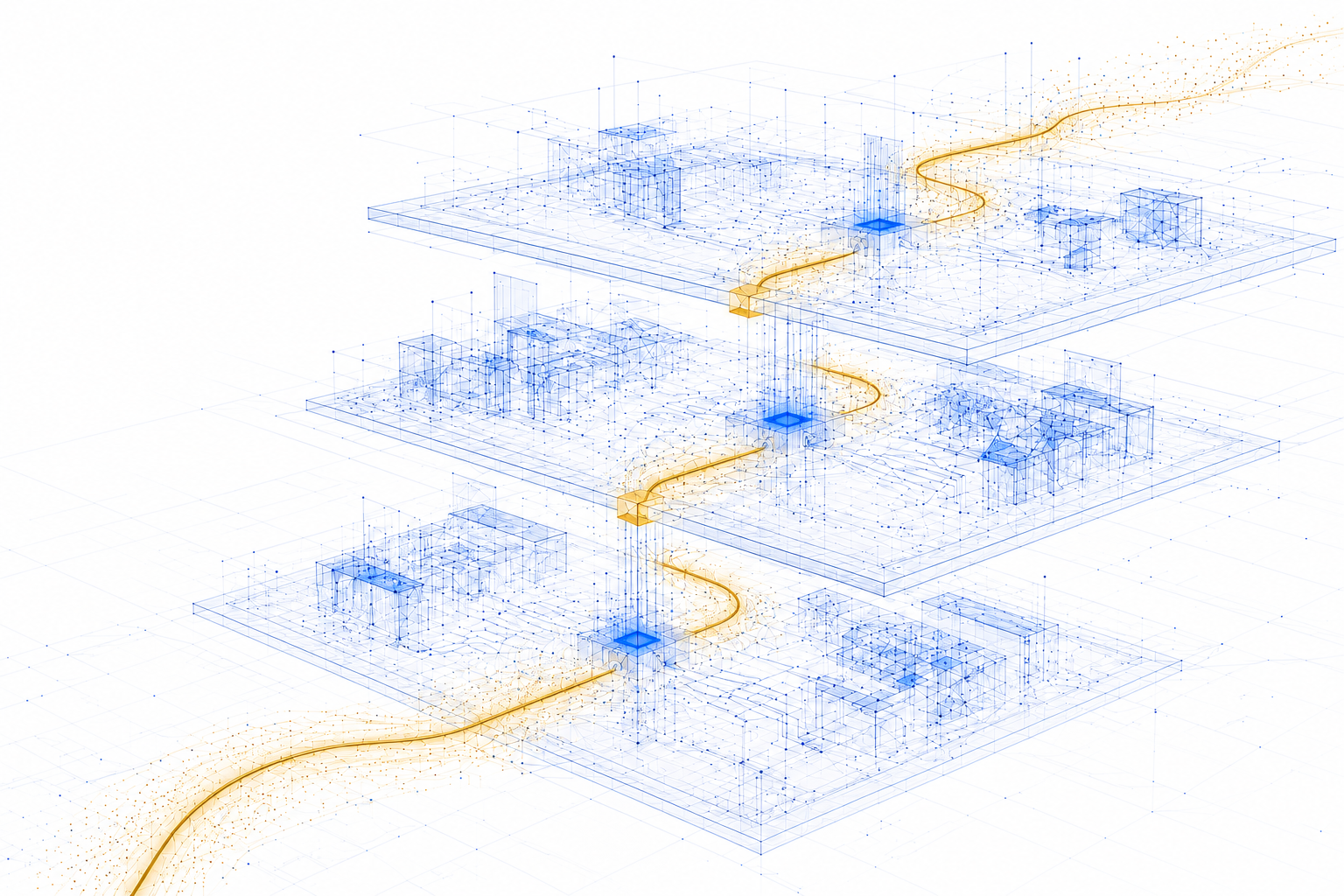
We learned to look up when someone said governance. Up the org chart, toward the people who approved the funding, set the direction, and met every quarter to ask how it was going. The work happened below. Governance happened above. Reports made the return journey, carrying an account of work already done.
There was a reason for the arrangement. When a meaningful piece of work took months, a decision could spend a week finding its way through the organization and still arrive in time to matter. Proposals had time to become presentations. Presentations had time to find a committee. The calendar was part of the machinery, and the machinery turned slowly enough that the calendar could keep up.
Lean Portfolio Management (LPM) was an important earlier answer to the distance between strategy and execution. It connected investment to value streams, made room for learning to change the plan, and gave more decisions to the people close enough to make them well. Adaptive planning and decentralized authority were already in the argument. [1] Continuous Governance builds on it for the AI era, when the timely supply of informed human judgment begins to determine how much of an organization's new execution capacity it can actually use.
The recognition underneath it is simple, and it changes where we look. Governance runs all the way down. The portfolio's funding decision is governance. So is the decision about what a specification means, what an agent may change, and whether the result is good enough to accept. Different authority, different consequences, different clocks. Keeping those judgments in resonance is what lets the whole organization move.
A team I work with used AI to compress a six-week deliverable into one week. The work improved. Refinement could not stay ahead of it. Stakeholders were available on the old rhythm. Portfolio assumptions about capacity and sequencing had moved, and PI Planning was still weeks away. In that team's experience, the next constraint had become visible. The organization had made the building faster and left the deciding on the old clock.
That is where this gets interesting. The precious input is human judgment. What is worth pursuing. Which tradeoff we can live with. Whether the thing that came back meets the need. Agents can help us think, prepare alternatives, and gather evidence. The responsibility for the call still belongs to a person, and a faster fleet gives that person more moments that matter.
I set out the foundations in my May 2026 white paper, Continuous Governance: The Practice of Structuring Human Judgment for the AI Era. [2] This article follows the practical question through the organization. How do we get judgment to the work while the work can still use it?
When the work outruns the decisions
Imagine the last few minutes of a demo. The product owner understands the business, has followed the work, and knows what she would recommend. The evidence is in front of her. On paper, she is empowered. In practice, there is someone she needs to run this one by, and their next available conversation is next week.
There is a whole range of arrangements hiding under that word, empowered. Some owners can make most calls themselves but have learned which ones need a quiet conversation first. Others need explicit approval, decision by decision. In many organizations, the title promises more authority than the person is actually allowed to exercise. The language of ownership has arrived. The decisions still travel.
The strongest arrangement brings the two things together in one person. Someone who knows what is needed and has the authority to decide, with clear boundaries around the calls that belong to them. That is the seat I describe in Decision Ownership. The knowledge and the authority meet where the work needs the answer.
Here I want to follow the wait when those things remain apart. It travels well beyond the team. A portfolio may be waiting to reconsider an investment whose assumptions have already changed. Two efforts may need the same expert, with neither authorized to decide which comes first. An executive may have new evidence about the strategy and nowhere to put it until the next review. Each is a different judgment, stranded on a calendar built for a different pace of work.
Software delivery has lived through a version of this before. Continuous integration made integration frequent and used automated builds and tests to expose problems while changes were still small. [3] Continuous delivery extended that discipline into a repeatable path toward release, keeping software ready to ship when the business needed it. [4] Work that had accumulated into a difficult event became a maintained capability.
Governance needs its own CI/CD moment. The analogy is about bringing a necessary discipline into the working cycle. Agents can carry much of the preparation. People still have to decide what deserves to proceed and what the evidence warrants. That judgment needs a reliable way into the work, with an owner who is available, informed, and allowed to make the call.
Our work labels are starting to reveal the same mismatch. Say epic in a planning conversation and the room pictures a substantial stretch of calendar. Say feature and a smaller stretch appears. Those words carry staffing and funding assumptions along with scope. A good specification, relevant context, and a capable agent fleet can now compress some surprisingly large assignments. The label may still describe the size of the change. It is becoming a less reliable clock.
The qualification is doing a great deal of work there. A good specification. Someone has understood the need, resolved the tradeoffs, named the constraints, and decided what evidence would make acceptance responsible. Writing those things down is an act of governance at team level. The specification is where an organizational intention becomes permission to do particular work.
If the spec is good, a small human crew can direct substantial execution against it. If it is vague, the fleet has more room to interpret, and the organization has more work to inspect. The judgment that shapes the assignment is part of the capacity to deliver it.
The push has a moment
The swing is the way I think about this.
Picture pushing a child on a swing. You watch the motion. You wait for the useful moment. A small push, well timed, carries the movement forward. The same effort at the wrong moment gets in the way. Anyone who has stood behind a swing knows the difference in their hands.
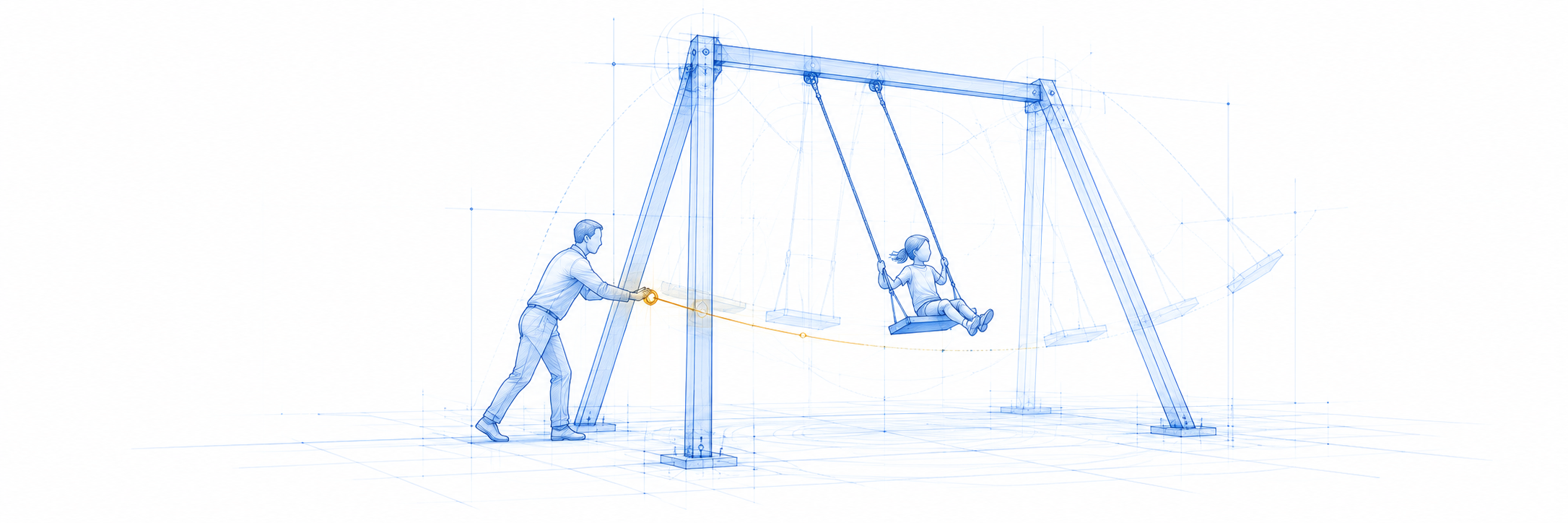
An expert's advice has that property. Before the spec is settled, it can shape the right work. After the build, the same insight can become a reason to do the work again. A portfolio decision can free a crew to proceed or arrive after the crew has spent a week pursuing the only path it was allowed to take. The quality of the judgment has not changed. Its usefulness has.
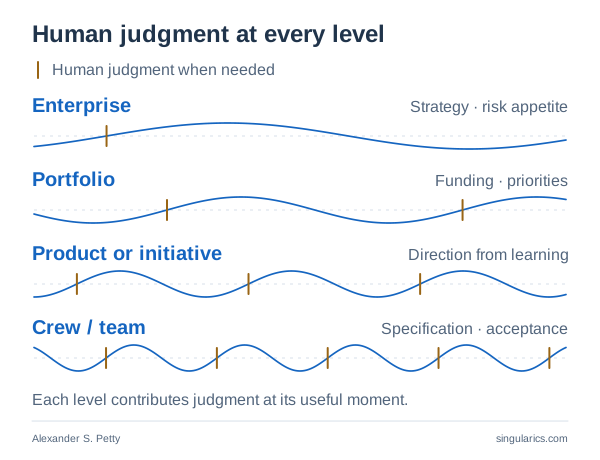
This is what I mean by resonance. The work and the judgments that guide it stay responsive to one another. A clear definition gives the next movement its direction. Acceptance closes that movement and makes the next one possible. A conflict the crew has no authority to settle reaches the person who can settle it, while the answer can still help.
Continuous governance is continuous access to human judgment.
The word access carries the design. A name on a chart supplies very little of it. The person needs current knowledge, usable evidence, sufficient authority, and time to participate when the decision becomes ready. Routine work can proceed within the authority already granted. The moments that need a new human judgment have somewhere to go.
Two human acts anchor the cycle at every organizational level involved in the work's lifecycle.
Definition gives permission to proceed. At portfolio level, someone commits to an outcome and the investment it deserves. At the crew, someone makes the next assignment clear enough to execute. In each case the judgment says what must become true, what must remain true, and what the people doing the work may decide for themselves.
Acceptance is the accountable judgment that the result meets the intent. A person examines an identifiable result, the criteria, and the evidence, and records what they decided and why. Where their authority includes release, acceptance can permit it. Where release belongs to someone else, that decision stays explicit.
The machinery can do an extraordinary amount between those acts. It can draft, build, check, and bring back evidence. The human contribution is concentrated at the places where direction and consequence meet.
A different clock at every level
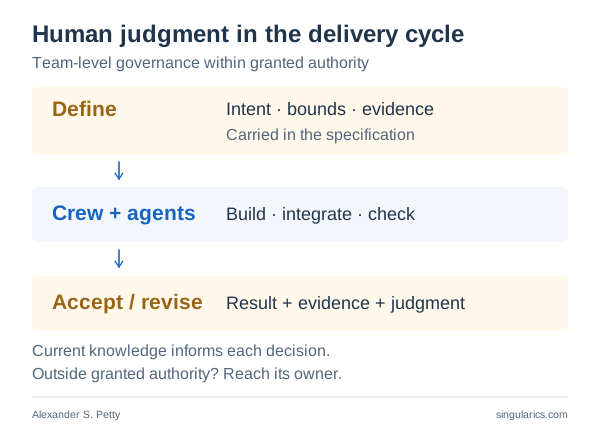
The swing gives us a way to think about timing. An organization has many swings moving at once.
At the crew, a question may become ready several times in a day. A spec takes shape, an assumption fails, a result arrives. At product level, learning changes what ought to be pursued next. At portfolio level, the judgment concerns competing outcomes, shared expertise, funding, and exposure. At enterprise level, the organization may need to reconsider its strategy or the risk it is willing to accept.
These decisions belong to different people for good reasons. They also become useful at different intervals. A portfolio office need not attend every acceptance conversation to stay connected to what those conversations are teaching it.
Suppose a portfolio can learn enough in a month to reconsider its commitments responsibly. A monthly conversation may make more sense than a quarterly one. By then, a crew may have met one need, found another more urgent, or discovered that a funded assumption will not survive contact with the work. Leaving the investment untouched for two more months has consequences, even if every team continues to deliver exactly what it was asked for.
Monthly is an example. The cadence has to earn its place through the decisions it serves, the evidence available, and the cost of waiting. Material changes still need a route between reviews, with a recipient, a useful response time, and someone who can act if the usual owner is unavailable. A scheduled conversation gives the portfolio a rhythm. Those routes keep the rhythm from becoming a reason to wait.
And the crew can stay on the effort until the need is met, through many definitions, acceptances, and releases, while the purpose and granted authority hold. A monthly portfolio review can renew that commitment, change it, expand it, or end it. The life of the effort belongs to the need. The review interval belongs to the judgments that keep the investment honest.
This is where the portfolio office becomes central. Whatever the function is called, it is where organizational strategy becomes a choice about what to fund, what expertise to supply, and what to stop doing. Strategy, funding, priorities, and authority travel into the work. Evidence, learning, new needs, and exceptions make the return journey. What returns must be capable of changing the next commitment and, when the finding is large enough, the strategy itself.
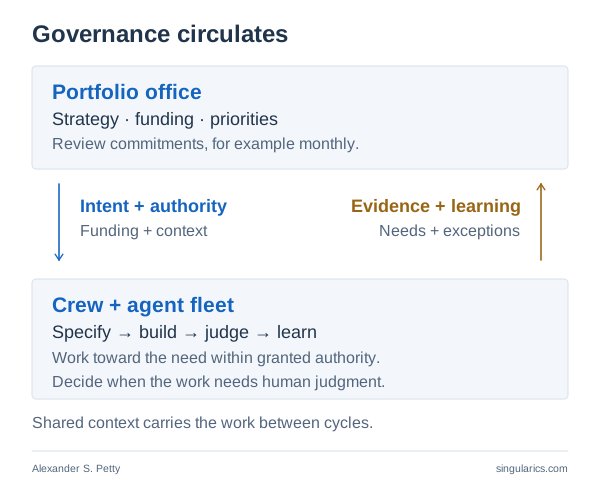
Imagine two crews with good specs and credible evidence, both needing the same domain expert tomorrow. Each effort makes sense on its own. The conflict belongs to the portfolio because the crews cannot resolve the organization's priorities between themselves. Now imagine one crew discovering that a much smaller change could meet the need. That finding belongs on the return path too. It may free investment for something the portfolio has been unable to start.
That is the circulation LPM helped organizations take seriously, carried down into the specifications and acceptance decisions that govern agent work. The work can teach the strategy. The strategy can change the work. Resonance is the discipline of keeping that exchange useful at every level.
What comes back has to mean something
There is a practical difficulty hiding inside the word evidence. Organizations produce plenty of it. The question is whether the person receiving it can tell what decision it supports.
Strategy lives in slides. Work lives in tickets. A check runs against a version of the software, and a presentation later says the outcome is green. Somewhere between those artifacts, several different claims have acquired the same color.
The harness, the repeatable checks that run against the work, helps establish whether a result satisfies the criteria it actually tested. The owner still has to judge whether those criteria captured the need. And the business outcome may require observation after the accepted change is in use. Those judgments have to remain connected without collapsing into one another.
Take a fictional effort to reduce avoidable service-request returns. An operations expert explains that on-site requests require a service location and remote requests do not. The owner authorizes clearer wording on the form, with the underlying rule, permissions, and routing preserved. The fleet returns a version whose field checks pass.
Then someone watches a remote requester use it. The requester still thinks a home address is required and abandons the request.
The checks supplied useful evidence about the fields. The observation supplied evidence about the need, and it changes the acceptance decision. The crew can correct the wording within its authority and bring back evidence on the revised version. Removing the location rule would be a different proposal, requiring the rule owner's judgment. Even after the wording is accepted, the portfolio still needs to learn whether avoidable returns actually fall.
That is quite a lot of governance inside one small form. There are distinct intentions, permissions, results, and decisions, and each has a person responsible for it.
The Organizational Intention Graph is the model's name for keeping that path intact. It is a living map connecting outcomes, authorized work, constraints, decisions, and evidence. Someone examining an increment should be able to follow it back to the reason it exists and forward to the judgment made about it. A finding that changes the outcome should remain attached to that change, so the next crew inherits the learning along with the work.
That is also the organizing purpose of Intent, the product we are developing to support the model. People provide the authority and judgment. The tool keeps their context and record connected. However an organization implements that record, a useful evidence package should let its recipient understand what was intended, what changed, what was checked, what remains uncertain, and what decision is needed. A smaller, answerable question often does more for flow than another comprehensive status report.
Keep authority connected to knowledge
Authority can send an organization in a direction with great clarity. It also has to leave room for someone close to the work to say that the direction is wrong.
The person carrying out an instruction may see an exception the decision maker has never encountered. An expert may know why the proposed change will fail. If bringing that knowledge forward is treated as resisting the instruction, the organization loses information it needs to make the call well. Everyone can follow the decision faithfully while the work supplies increasingly good reasons to revisit it.
Continuous Governance depends on keeping that conversation possible. The people with relevant knowledge need a recognized way to inform and challenge a decision. The owner remains accountable for the call, including whether new evidence changes it. A question that crosses the owner's authority can travel to the portfolio or the policy owner with the evidence attached. The return path gives learning somewhere to go.
That path starts before execution. The expert behind a specification knows things the specification has not yet learned to say. Which exception matters. Why a rule exists. What customers do when the official process becomes inconvenient. That knowledge needs to reach the owner while it can still shape the assignment.
There is a long intellectual history here. In 1994, Ikujiro Nonaka described organizational knowledge creation as an ongoing exchange between tacit knowledge, held through experience, and its explicit forms. Individuals develop knowledge, and the organization has a role in articulating and amplifying it. [5] The practical implication for agent work is immediate. What an expert knows has to become available in forms the work can use, while the expert remains available for the judgment those forms cannot carry.
I explored that layer in The Knowledge Layer. The Knowledge Network gives the contribution an owner, funded time, and a place in the working cycle. The recurring rule can become a check. The example can enter the shared context. The interpretation that depends on this particular situation still needs someone who understands it.
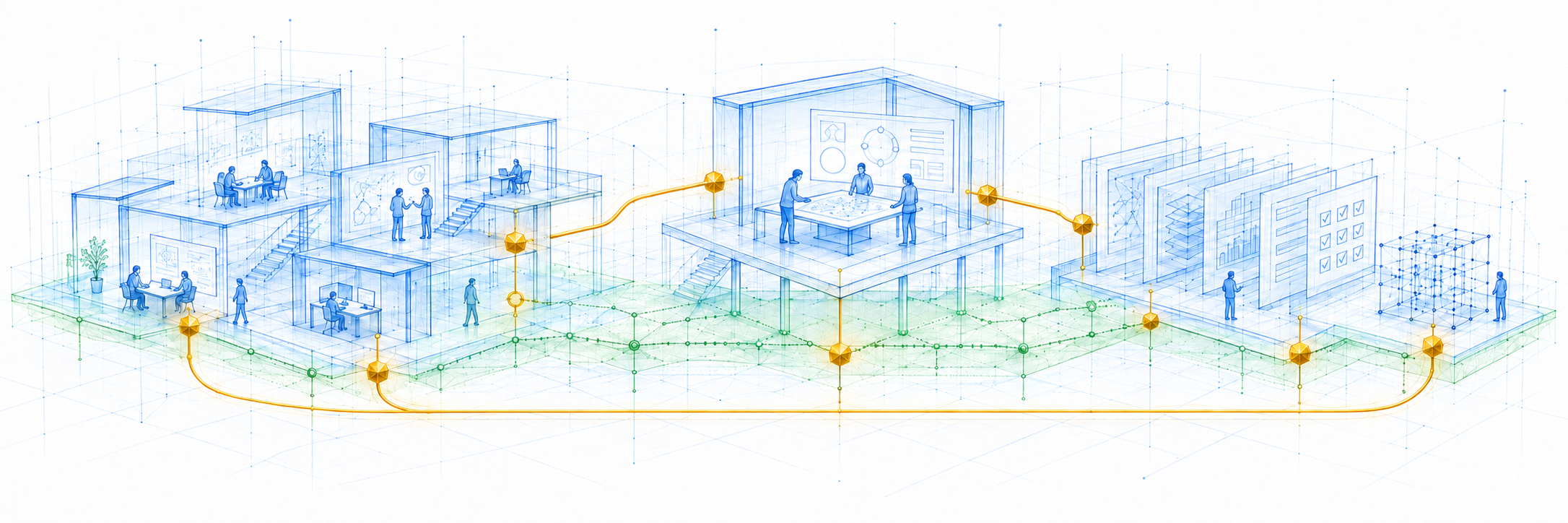
Inject expertise while the work is taking shape. Encode what can be carried forward. Return what the work teaches to the people who keep the knowledge current. Those three moves let one afternoon's contribution serve later work without pretending the afternoon captured everything the expert knows.
The expert also has to keep spending time where the business happens. A well-maintained library can still contain an obsolete understanding if nobody maintaining it has noticed that customers or operations have changed. The network needs contact with the world as surely as the fleet needs contact with the network.
This is governance too. Deciding what knowledge an effort needs, who will supply it, and how their time will be paid for determines what the effort can responsibly do.
A small fleet can stay with the need
Once context and judgment are organized this way, the shape of the team can change.
A small human crew can concentrate an agent fleet on a need and stay with it through the learning required to meet it. The Decision Owner carries current business knowledge and personally defines and accepts within granted authority. The Fleet Lead directs execution and holds the technical understanding, the reasons the system has its shape and the consequences of changing it. The Intent Architect helps make authorship, context, and evidence coherent across the organization. Specialists join through the knowledge network as their knowledge becomes necessary.
The execution capacity around that crew can swell and thin. An agent joining the work needs the current intention, authorized spec, relevant knowledge, code, results, prior decisions, and unresolved questions. With that context maintained in a shared source, it can pick up from where the last work left off. A person arriving can recover the record and ask what the record has not settled.
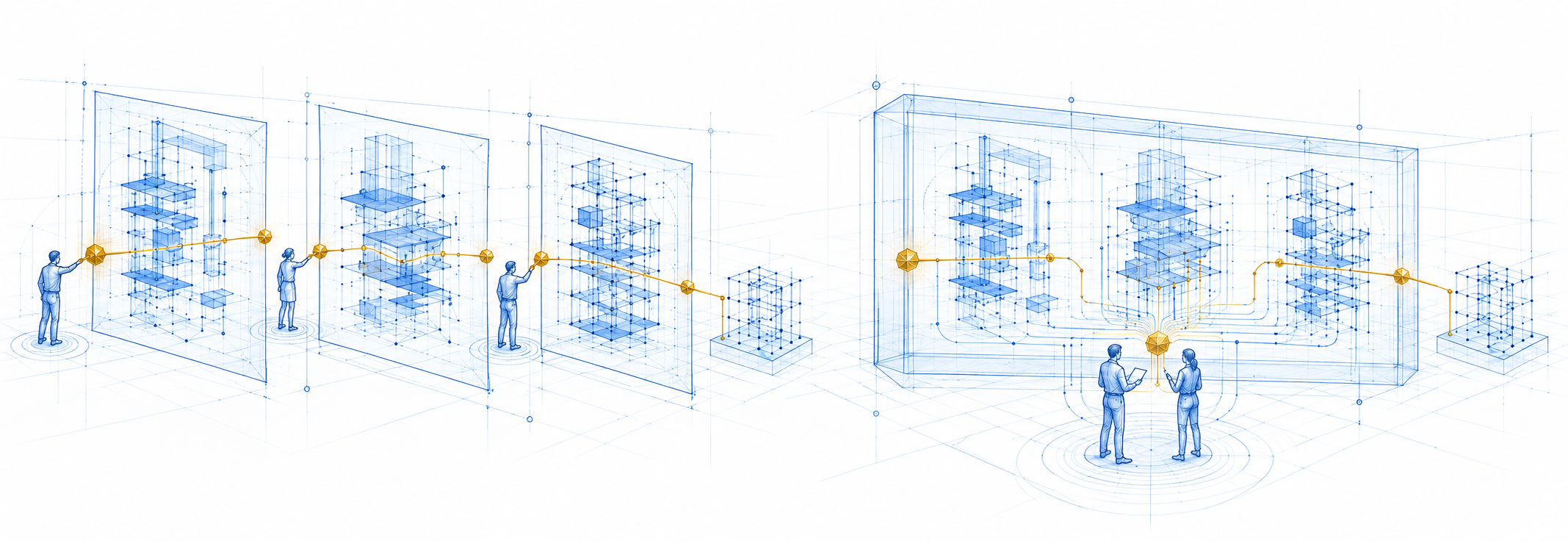
That makes more of the capacity transferable. The effort keeps its history as agents change around it. A fleet can swarm a substantial assignment, reduce when the next move needs human investigation, and expand again when the spec is ready. The portfolio has more choices than adding another permanent team to every new commitment.
There is still craft in carrying work across that change. Someone must understand the software, integrate what arrives, and review it meaningfully. A maintained context helps that person hold the work. It cannot take responsibility for them. The useful size of the fleet is bounded by what the crew can actually guide and judge.
Staff for the judgment you can supply
Do yourself a favor. Do not staff more teams than your available Decision Owners can meaningfully support. Putting the same name beside another team creates another claim on a person's time. It creates none of the time.
This is Goldratt's Theory of Constraints showing up in a new part of the organization. When informed human judgment is the binding constraint, more execution can produce a larger queue of proposals, questions, and finished work for the same overloaded owner. The Five Focusing Steps direct attention to using the constraint well, organizing the rest of the system around it, expanding its capacity, and then looking again for what limits the whole. [6]
Picture the staffing conversation. The budget can support another crew. The tools are available. Someone adds a box to the plan and puts the existing owner's name beside it. Definition now competes with acceptance, acceptance with exceptions, and all three with the business contact that keeps the owner's judgment current. A month later, the organization wonders why its additional capacity has produced so much waiting.
Before funding the next start, establish whose decisions it will need and where that person's time will come from. Account for existing commitments and leave room for the question nobody could schedule in advance. The team count should follow what those people can meaningfully support.
Fund the Knowledge Network behind them as part of the same decision. Give experts protected time, keep them connected to the business, and carry recurring knowledge into the context and checks. Free owners from work others can do, grant the authority their decisions require, and develop more people who can take the seat. If ready decisions are already accumulating, limit new starts while that constraint is addressed. Then look again. The next limit may be technical integration, customer access, or something else the faster system has made visible.
The portfolio's staffing decision is itself Continuous Governance. It determines whether the judgments promised by the operating model will have people behind them.
Give one decision its moment
A change this large is going to be learned in small encounters with real work. I think that is the honest way into it.
Start with one waiting decision. Choose an outcome where the people involved can see the whole path. Name the judgment, its owner, and the authority it requires. Find out whether the wait is for evidence, expertise, permission, or a place on someone's calendar. Each asks something different of the organization.
Move that judgment closer to the moment it can help. Give its owner the necessary context, evidence, authority, and time, with a clear route for the exceptions that belong elsewhere. Follow several cycles. Notice when a decision became ready, when it was made, and when the work could use it. Time spent finding out enough to decide responsibly has a purpose. Time spent waiting with the answerable question already in hand deserves an explanation.
Watch what happens beyond the decision too. Does rework fall? Does the result help the people it was meant to serve? Has the queue simply moved to another desk? Learn from the whole path before expanding the change.
Return to the team that finished six weeks of work in one. Its achievement asked something of everyone around it. The owner needed to be ready with the next meaningful judgment. The experts needed a way into the spec. The portfolio needed to hear what had changed while it could still change the investment. Making one team faster had exposed a design question for the organization.
Continuous Governance is the direction I am working toward for that organization. LPM brought strategy and investment into a more adaptive relationship with delivery. The next step carries that relationship through the whole lifecycle, down into the spec and back through the evidence, with human judgment supplied at each level's useful rhythm. We will have to learn the details by doing it, with the people who know the business and live with the consequences.
The next time someone says governance, I would like us to picture that whole movement. The portfolio choosing what deserves to exist. The expert shaping the spec. The owner examining what arrived. The learning returning in time to change what happens next. A small push at the right moment, wherever in the organization that moment comes.
Get the flow of judgment right, and the flow of work largely follows.
References
- Scaled Agile, Inc. (n.d.). Lean Portfolio Management. SAFe. Adaptive planning, value-stream funding, and the connection between strategy and execution.
- Petty, A. S. (2026, May). Continuous Governance: The Practice of Structuring Human Judgment for the AI Era. Singularics. The earlier white paper on which this article builds.
- Fowler, M. (2024, January 18). Continuous Integration. Revised account of frequent integration, automated verification, and rapid feedback.
- Humble, J., & Farley, D. (2010). Continuous Delivery: Reliable Software Releases through Build, Test, and Deployment Automation. Addison-Wesley Professional.
- Nonaka, I. (1994). A Dynamic Theory of Organizational Knowledge Creation. Organization Science, 5(1), 14–37.
- Theory of Constraints Institute. (n.d.). The Five Focusing Steps (POOGI). Goldratt's process for identifying and improving the system's constraint.
Alexander S. Petty is the founder of Singularics. He has spent 20 years leading enterprise transformations and now helps organizations redesign how work is defined and coordinated when AI changes the operating model.
Singularics AI-native advisory helps organizations work through those first cycles, connect the roles and expertise, and learn what their next step needs. Start a conversation.